Showing posts with label animals. Show all posts
Tuesday, 28 January 2020
Ermine (stoat)
The ermine (Mustela erminea) is a member of the weasel family that is best known (in Great Britain at least) for supplying the black-spotted white fur that has traditionally trimmed the ceremonial robes of members of the House of Lords.
It is a small animal measuring up to 12 inches (30 centimetres) in length which includes its black-tipped tail (up to 5 inches or 12 cms).
Somewhat confusingly, the ermine only exists during the winter months! At other times its fur is similar to that of the larger weasel, being reddish-brown above and on the head and white below. This is when it is known by the more familiar name of stoat.
The ermine has short legs, a long neck and a triangular head.
In order to survive, an ermine must eat every day. It is therefore a fearsome hunter of small mammals, which it will kill by trapping it with its legs and biting it on the back of the neck. The female ermine is roughly half the size of the male, which allows it to feed its young by hunting underground in burrows where a prey animal might have thought it was safe.
The ermine is sometimes forced to diversity its diet and will take small birds, eggs, fish or insects if necessary.
The fur of victim mammals is used to line the ermine’s nest, where a litter of four to nine offspring will be raised. The young are ready to join their mother in the daily food hunt when they are around two months old.
© John Welford
Moufflon
The moufflon (Ovis musimon) is a wild sheep that is thought to be one of the ancestors of the modern farmed sheep.
A fully grown mouflon is around 120-140 centimetres (47-55 inches) long, 60-120 cms (23-47 inches) high at the shoulder and weighs from 25 to 55 kgs (55-121 lbs).
The coat is reddish-brown with a dark stripe on the back and a light-coloured saddle patch and underparts. Male moufflons have a mane and very large spiral horns.
Evolution is behind the size and splendour of the ram’s horns, which arch back and then swing round to the front in a graceful loop that frames the ram’s face. The bigger they are, the greater the ram’s status in the herd and more likely he is to be able to fight off rivals and ensure that the next generation carry his genes.
Fights only take place when the horns are not impressive enough to frighten off an opponent. The heads go down and the horns bash against each. Hence the reason why rams are called rams!
Unfortunately, mouflon horns are also prized as trophies and many a splendid mouflon ram has lost his life to a hunter as a result. Moufflons originated on the Mediterranean islands of Corsica, Sardinia and Cyprus, but very few live there now. Fortunately, the species was introduced to mainland Europe where it continues to thrive.
© John Welford
Wednesday, 31 July 2019
Dhole
The dhole (Cuon alpinus), which is also known as the Asian red dog or Indian wild dog, is widespread throughout south, east and southeast Asia, although its overall numbers are in decline.
It measures up to 90 cm (35 in) in length and weighs 15-20 kg (33-44 lbs). The fur colour is tawny or dark red with a darker tail and lighter underparts.
Dholes live in packs of 5 to 12 animals, which usually comprise an extended family. The main prey of dholes is medium-sized hoofed mammals, but they will also eat smaller animals, fruit and other plant food.
© John Welford
Wednesday, 3 July 2019
Klipspringer
The klipspringer (Oreotragus oreotragus) is a small
tiny-hoofed antelope that lives in mountainous areas of eastern and southern
Africa.
It measures up to 4 feet (1.2 metres) in length and weighs up
to 40 pounds (18 kg). It has a glossy olive-yellow coat with yellow and brown specks,
fading to white on the underparts and legs. Male klipspringers have small,
spiky horns.
Klipspringers browse on evergreen shrubs and live in pairs, raising
up to two young at a time.
© John Welford
Tuesday, 2 July 2019
Nilgai
The nilgai (Boselaphus tragocamelus), which is also known as
the bluebuck or blue bull, is an Asian antelope that is endemic to India.
It measures up to 7 feet (2.1 metres) long and stands up 21
inches (53 cms) high. It weighs up to 660 pounds (300 kg). The front legs are
longer than the rear ones. Male nilgai have stout tapering horns up to 8 inches
(20 cms) long and also sport a throat tuft.
The male’s coat is bluish grey and the female’s is tawny
coloured.
The nilgai prefers open woods to thick forest and is very
alert to danger, fleeing at speed from predators, which include tigers.
Nilgai graze on grasses of various types and browse leaves
and fruit from bushes, feeding during the early morning and early evening while
resting in seclusion during the hot part of the day.
Male nilgai compete for territory and females by kneeling in
front of each other and lunging with their horns. Successful males are able to
acquire harems of up to 10 females.
Breeding occurs throughout the year, although most calves
are born between June and October.
© John Welford
Tuesday, 19 June 2018
Fossa
The native fauna of Madagascar bears very little resemblance
to that of the neighbouring continent of Africa, due to the separation event
that occurred around 160 million years ago. A lot of divergent evolution has happened
since then!
The fossa (Cryptoprocta ferox) is an animal that occupies
the “big cat” niche in Madagascar’s fauna, although it belongs to a more
primitive family of animals that includes civets, genets and mongooses.
Like a big cat, the fossa is lithe and agile and hunts by
stalking and pouncing on its prey. It is muscular, powerful and an excellent
climber.
An adult fossa measures 23-30 inches (60-75 cms) in length and
stands 22-28 inches (55-70 cms) tall. It weighs 21-31 pounds (9.5-14 kgs).
Fossas are solitary animals that hunt by day or night. A fossa
will patrol an area of 1.5 square miles (4 square kms) or more, which means
that the species has a low population density and individuals are not easily
seen.
Fossas originality hunted members of another of Madagascar’s
unique animal groups, the lemurs, but as numbers of the latter have declined,
fossas have been forced to take pigs, poultry and other domesticated animals.
That has made them targets for persecution by humans which, together with
habitat loss, has added the fossa to the list of highly endangered species.
© John Welford
Friday, 23 March 2018
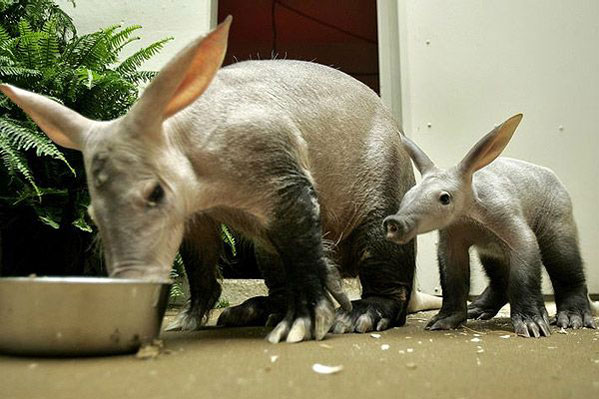
Aardvark: a living fossil

The aardvark is a strange-looking creature
– to us, that is, no doubt it looks perfectly normal to other aardvarks. The
name is Afrikaans for “earth pig”, but it is certainly not a pig despite some
superficial resemblances. It does, however, do a lot of rooting about in soil
and termite mounds for its food, which consists of ants and termites.
One of the more remarkable things about the
aardvark is that it is a “living fossil”. When its mitochondrial DNA was
sequenced in 1999 it was discovered that the aardvark could be the closest
living relation to the first placental mammals that walked on planet Earth some
100 million years ago. It appears that its DNA has undergone hardly any change
during that time. This posits the idea that the earliest placental mammals
(i.e. not marsupials or monotremes) may have looked something like modern
aardvarks, but we cannot be certain of that.
Another finding that came from the DNA
analysis was that the aardvark is more closely related to the elephant than to
the anteaters of South America, despite occupying a similar ecological niche to
the latter.
© John Welford
Thursday, 22 March 2018
Some non-native species in Great Britain

Although Great Britain has a rich and
diverse native wildlife, there are several species that would not be present
were it not for human interference. Some of these introduced species are
welcome additions, but others are much less so.
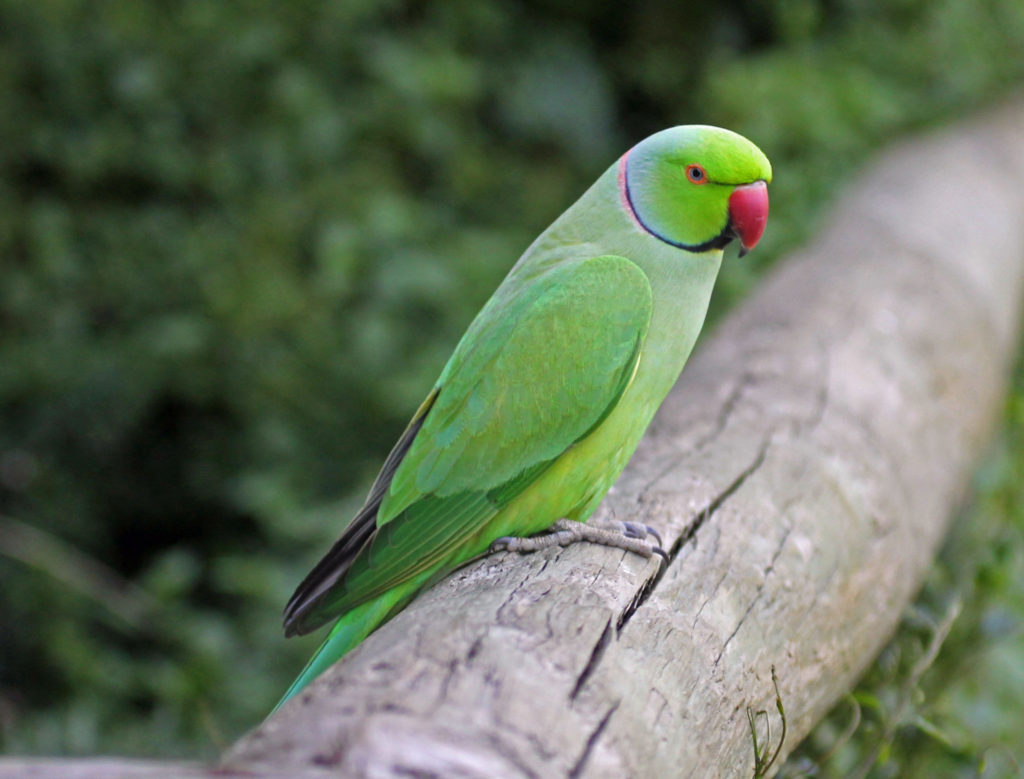
Parakeet – this bright green bird belongs
to south Asia and sub-Saharan Africa, but it can also thrive in temperate
climates such as that of western Europe (including southeast England where
large flocks have established themselves). The current population probably bred
from escaped cage-bird pets.
Muntjac – this small deer species was
introduced from Asia around 100 years ago, but individuals that escaped from a
wildlife park led to successful wild populations becoming established.
Mink -
these were introduced from America to be farmed for their expensive fur,
but escapees soon found their way to England’s rivers where they caused havoc
with populations of native animals such as water voles.
Grey squirrel – another American import
that has had a devastating impact on native wildlife, particularly the red
squirrel. The latter is now confined to a few isolated places in the British
Isles, leaving the greys as the only squirrels that most people ever see.
Red-necked wallaby – an escapee from
wildlife parks that has bred in the wild in places such as Scotland, Sussex and
the Peak District. Marsupials belong to Australia, not Great Britain!
Red-eared terrapin – this is an American
species of “water tortoise” that was brought from America to be sold by pet shops.
Unfortunately, they can give a nasty bite, and many owners thought they were
doing the right thing by releasing them into rivers and canals. Unfortunately,
they now attack native wildlife such as ducklings.
All in all, the import of non-native species
has not always been a good idea due to the unintended consequences when escaped
pairs create feral populations. It seems as though it is imports from the
Americas that have proved to be most problematic!
©John Welford
Subscribe to:
Posts (Atom)