Saturday, 16 June 2018

Field penny-cress


Field penny-cress (Thlaspi arvense) is found on wasteland throughout Great Britain, although it is a non-native species. It is possible that the plant came into the country accidentally alongside a consignment of crop seeds.

 It is an unwelcome weed when it invades farmland, especially as grazing animals refuse to feed on it due to its unpleasant smell when crushed or bitten. 

Field penny-cress has upright leafy stems, sometimes with branches, that grow to a maximum height of 24 inches (60 centimetres) when flowers and then fruits are produced. The leaves are narrow, toothed and stalkless, grasping the stem at their base. 

The small white flowers appear from May to July. They grow on stalks and in clusters. The fruit are what give the plant its name, because they are almost circular and flat, with broad wings, albeit with a notch at the top. The size of the fruits, at up to three-quarters of an inch across, is not far short of that of a modern British penny, but it is very much smaller than the pre-decimalisation pennies that were around when the plant would have acquired its name. Curiously enough, the plant has a similar name derivation in German, being the “feld pfennigkraut” – maybe the old pfennig was closer in size than the old penny!

© John Welford

Thursday, 14 June 2018

Yellow horned-poppy


The yellow horned-poppy (Glaucium flavum) is a native of Europe and western Asia but is a familiar wild flower on shingle beaches all round the coast of Great Britain except for northern Scotland. This suggests that the plant might have reached these shores courtesy of a shipwreck centuries ago and spread along the coast. Despite its preference for shingle beds above the high-water mark, it will also grow on sand and cliff tops. 

The yellow horned-poppy will grow up to 36 inches (90 centimetres) high, but many specimens are much more low-lying than that due to being constantly battered by winds off the sea. The lower leaves grow on stalks off the main stem and have hairy lobes, whereas the upper leaves clasp the stem and have less prominent lobes.

The bright yellow flowers are up to three inches (7.5 centimetres) across and are seen from June to October. They are succeeded by seed capsules that are long and thin, up to 12 inches (30 centimetres) in length, and these form the “horns” that give the plant its name. 

The yellow horned-poppy has an orange-coloured, foul-smelling sap that is highly poisonous, as are all parts of the plant. This is a wild flower that should be admired from a safe distance rather than be handled.

© John Welford

White water-lily


The white water-lily (Nymphaea alba) is a favourite plant for owners of ornamental lakes and large ponds, although it grows wild throughout Great Britain and is native to Europe. It may have been introduced to Britain by the Romans.

Water-lilies are typified by being rooted in the beds of ponds and lakes but exhibiting their leaves and flowers on the surface. In the case of the white water-lily, the fleshy stems can grow as deep as six feet (1.8 metres) below the surface, but the stems on which the leaves and flowers grow can be up to nine feet (2.75) long, which means that the visible parts of the plant can drift away from the point directly above the root.

The leaves are nearly circular, being green above and reddish underneath. The flower is the largest in the British native flora, being up to 12 inches (30 centimetres) across. The whole plant can spread to up to five feet (150 centimetres) in diameter. 

The flowers usually have at least 20 petals, often many more, with four sepals beneath that are white inside and green outside. The flowers only open towards the middle of the day and close as evening approaches. The flowers can be seen from June to August.

The white water-lily has been appreciated and admired for centuries, gaining familiar names such as “the lady of the lake” and “swan among the flowers”. It has acquired a symbolic value as an indication of purity and it has also been used for medicinal purposes as it yields an oil that is good for treating skin blemishes and other conditions.

© John Welford

Wednesday, 13 June 2018

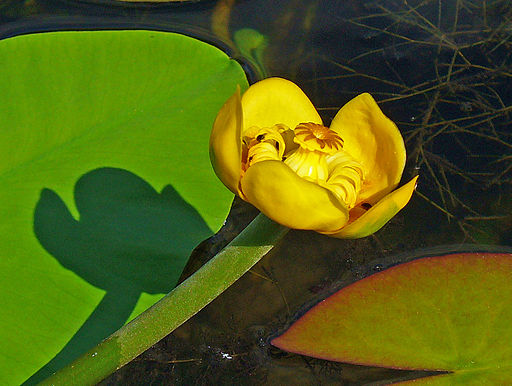
Yellow water-lily


The yellow water-lily (Nuphar lutea) is less common than the white variety, but is still found quite widely, both in ornamental ponds and in the wild, where it favours still and slow-moving water.

It grows from fleshy stems rooted in the mud at the bottom of lakes and streams. Stalks up to nine feet (2.75 metres) long then grow towards the surface where the leaves and flowers float, although some leaves stay submerged. The floating leaves are the largest of any water plant found wild in Great Britain, measuring up to 16x12 inches (40x30 centimetres). The yellow flowers are only 2-3 inches (5-7.5 centimetres) across, comprising many petals surrounded by five or six sepals.

The seed capsules take the shape of a flask, which is one reason why the yellow water-lily is also known as the “brandy bottle”, the other reason being that the flowers have a scent reminiscent of stale alcohol! The capsules contain air pockets that enable them to float away from the host plant before they sink and release their seeds.

Preparations made from yellow water-lilies have the effect of inhibiting sexual drive. This property was found to be useful in medieval monasteries and nunneries, where celibacy was the order of the day. Images of yellow water-lily flowers have been discovered in carvings in abbeys and cathedrals, presumably for the above reason.

© John Welford

Tuesday, 12 June 2018

Welsh poppy


The Welsh poppy (Meconopsis cambrica) is easily distinguished from the common poppy by having yellow rather than red flowers. There are other differences, such as the seed capsules being differently shaped, but they are not enough to justify the botanical name “Meconopsis”, which means “looking like a poppy”.

Despite its name, the Welsh poppy is not restricted to Wales, being also found in southwest England and parts of Europe. It has been cultivated as a garden flower and may therefore be found in places outside its normal range, due to garden specimens having cast their seed more widely and produced wild plants. It prefers damp shady woods and rocky places. 

The plant separates into many branches at the base, with the leaves also splitting into numerous leaflets. The Welsh poppy thus has a bushy appearance, growing up to 24 inches (60 centimetres) in height. The relatively small yellow flowers, which do not have dark centres, have four petals. They appear in the months of June and July. 

The seed capsules, as noted above, are slightly different from other poppies in that they release seed from open flaps rather than “pepperboxes”.

© John Welford

Monday, 11 June 2018

Swine-cress


Swine-cress (Coronopus squamatus) is also known as hog-cress and sow-cress, but there is no direct link between this plant and pigs. It may simply be that, in past times, it was used as a salad ingredient but was of such low quality that it was deemed to be fit only for pigs!

Swine-cress is found on waste ground in southern Britain but is less common in the north.

It is a greyish, low-growing plant that reaches up to 12 inches (30 centimetres) in height. It has small, finely divided leaves. The tiny white flowers, which appear from June to September, grow in small clusters in the angle of stem and leaf-stalk.

Yet another name for this plant is wart-cress, and this derives from the appearance of the fruit which has a wart-like surface. Each fruit produces one or two pear-shaped seeds.

This unprepossessing plant has a surprising relative, namely the garden wallflower, although they would seem to have hardly anything in common. The link can, however, be seen in the construction of the flowers, especially the cross-shaped arrangement of the petals.

© John Welford

Spring beauty


Spring beauty (Montia perfoliata) is a plant that found its way from the Pacific coast of North America to Great Britain during the 19th century, being first seen in Britain in 1852. In its original homeland it is known as Indian lettuce and miner's lettuce, although native Americans ate its bulbs as well its leaves.

It is found throughout Britain growing mainly on disturbed and waste ground, with a preference for sandy soils.

An unusual feature of spring beauty is that its leaves - apart from those at the base of the plant - fuse together in pairs to completely surround each flowering stem. The flowers therefore appear to grow out of a single leaf which forms a bowl shape. This is known as perfoliation, which gives the plant its botanical name.

Spring beauty grows to a height of between 4 and 12 inches. The flowers, which appear between May and July, have five notched white petals and two sepals.
© John Welford