Showing posts with label Wildflowers. Show all posts

Friday, 12 March 2021

Opposite-leaved golden saxifrage


Opposite-leaved golden saxifrage (Chrysosplenium oppositifolium) grows as a gold-speckled pale green mat on the banks of small streams in shady places on rocks and in woods, throughout Great Britain. It varies in size from comparatively large specimens in lush, damp surroundings to small, dense tufts in more open, drier areas.

Plants grow up to 6 inches (15 cm) high, with flowering stems standing out from a low, sprawling mass of leafy shoots that take root at intervals. The rounded leaves, which are usually bluntly toothed, thin and crisp, grow as opposite pairs (hence the plant’s name). The stalks are about the same length at the blades.

Opposite-leaved golden saxifrage flowers from April to July. The flowers have four sepals but no petals. A raised, lobed disc surrounds the styles. The fruit opens by splitting along the inner edge.

The leaves were formerly eaten as a vegetable. It was once thought that their shape resembled that of the human spleen (hence the “splenium” part of the Latin name) and – to the medieval mind – that meant that they were designed by God to provide cures for diseases of that organ (this is referred to as the “doctrine of signatures”). Infusions of the plant were therefore drunk, as well as the leaves being eaten.

There is a related plant – alternate-leaved golden saxifrage (Chrysosplenium alternifolium) that has kidney-shaped leaves growing alternately. The stalks and flower stems are longer, and it does not have creeping stems so does not form mats. It is, however, more robust than opposite-leaved golden saxifrage and grows further inside crevices in mountainous regions.

© John Welford

Thursday, 11 February 2021

Mossy saxifrage


Mossy saxifrage (Saxifraga hypnoides) is a plant that, although it can occasionally be found growing wild in lowland sites in the United Kingdom, generally prefers hills and mountains, notably in Snowdonia, the Pennines, the Lake District and Scotland, sometimes as high as 4000 feet (1220 m) above sea-level. An alternative name is Dovedale moss, which refers to a location in the Peak District.

It can assume widely diverse forms, depending on its environment. In very moist sites it may be long and trailing, but in drier or more exposed areas it will form a wide, creeping mat. It usually grows on mountain ledges and scree, if the soil is non-acid, and on open, grassy hillsides.

Mossy saxifrage can grow to between 2 and 8 inches (5-20 cm) in height. The leafy lower shoots spread in a tangled mat, while the flowering stems carry little foliage. A notable feature is that some of its branches are barren and others fertile, carrying attractive white flowers (between May and July) in groups of 1 to 5. The flower buds are often tipped with pink. The sepals do not bend back but remain upright. When ripe, the fruits split at the top.

This is a wildflower that has also found a home as a garden plant, its creeping nature and showy, white flowers making it a popular edging plant for herbaceous borders and a fill-in plant in rockeries.

© John Welford

Monday, 4 January 2021

Meadow saxifrage


Meadow saxifrage (Saxifraga granulata) grows in non-acidic well-drained soils, mainly in the eastern parts of the United Kingdom such as the Breckland area of Norfolk. It used to be more widespread in meadows throughout much of Britain, but the uprooting of hedges has been a major element in its decline.

Meadow saxifrage grows up to 20 inches (50 cm) in height, each plant having a single stem that is straight and hairy until it branches near the top. It has long-stalked, kidney-shaped leaves that are hairy and toothed or lobed. Leaves that encircle the base may wither when the flowers appear. The flowers, which appear between April and June, have narrow white petals with green veins. When ripe, the fruit splits open at the top to release the seeds. Tiny bulbs form where the stalks of the lower leaves join the stem. These bulbs are the means by which the plant perpetuates itself.

The word saxifrage means ‘stone-breaking’, and it is possible that this name was originally given to the plant by the Romans because they found it growing in crevices of rocks and wrongly assumed that it had been responsible for breaking those rocks apart.

However, according to Pliny the Elder, the plant was given the name because it had the medicinal power of breaking up gallstones in the bile duct. This idea almost certainly came from the ancient belief that plants with powers to cure disease display a sign to indicate how they should be used. It was therefore ‘obvious’ that a plant that grew stone-like brown bulbs around the base of its stem was intended to dissolve small stones in the body.

© John Welford

Wednesday, 18 November 2020

Starry saxifrage


Starry saxifrage (Saxifraga stellaris) is a common plant found on wet, stony ground in the mountainous areas of the British Isles. Its tough, penetrating roots exploit the natural cracks and crevices in the rock and anchor it so firmly that it has gained a reputation, like other saxifrages, of being able to carve out its own foothold by actually cracking the stone. This belief, still widespread though erroneous, is reflected in the origin of the plant’s scientific name Saxifraga, which combines the Latin words saxum, meaning ‘rock’ and frango, meaning ‘break’.

The plant grows up to 10 inches (25 cm) in height. It has a rosette of toothed leaves at the base, but the upper parts of the stem are leafless. The low-growing leaves are less exposed to mountain winds, and their closeness to each other help to conserve moisture. The leaves are short-stalked, toothed and hairy on the top surface.

Flowers appear between June and August. They are white with conspicuous red anthers. There are two yellow spots at the base of each petal. The sepals are bent back. The seed capsule splits to the middle or below when ripe.

Ancient medical lore often believed that a plant with particular characteristics that related to an element of human anatomy had been prescribed by God as a cure for ailments relating to that element. Thus a decoction of "stone breaking" starry saxifrage was applied to curing kidney and gall stones in the human body. A 17th-century medical textbook also recommended that saxifrage roots, mixed with wine and vinegar, would cure the plague.

© John Welford

Wednesday, 11 November 2020

Navelwort


Navelwort (Umbilicus rupestris), otherwise known as wall pennywort, is often found growing on high roadside banks in western England, Wales, and western Scotland. It is much less common further east. It grows between stones in the banks and also in rock crevices and on sea cliffs.

The size of the plant varies greatly according to its position. Lush, branched specimens spring from moist and shady surroundings, whereas much smaller plants cling to dry walls or exposed cliffs. The plant can therefore vary from 4 to 16 inches (10-40 cm) in height.

Disc-shaped leaves, depressed at the centre, grow on long stalks. Numerous greenish-white bell -shaped flowers appear on tall, narrow spikes between June and August.

The plant ‘s common and scientific names all refer to the unusual shape of the leaves – pennywort from their supposed resemblance to an old penny coin, and navelwort to the central, navel-like dimple. The word umbilicus is Latin for navel, and rupestris means ‘a plant that grows on rocks’.

© John Welford

Thursday, 5 November 2020

Reflexed stonecrop


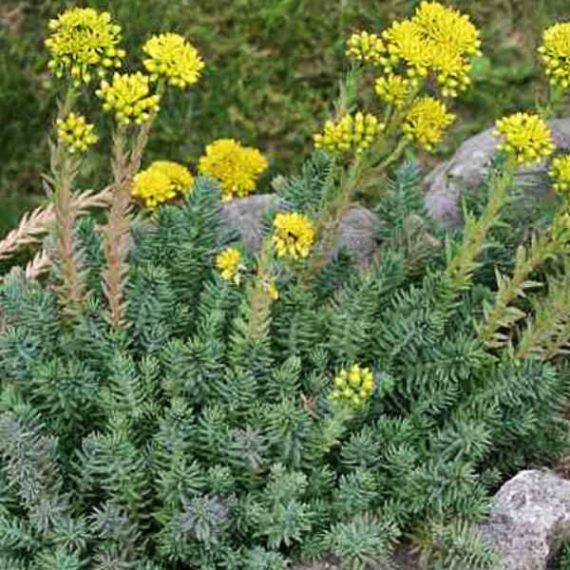
Reflexed stonecrop (Sedum reflexum) is a plant that was introduced from Europe into Great Britain. Originally grown as a cultivated plant, it spread beyond gardens into the land beyond and now grows in the wild on old walls, rocks and other suitable habitats, especially in southern Britain.

A crop is a dense head of flowers, and the name stonecrop comes from the plant’s habit of growing on stone walls. Reflexed stonecrop is so called because the lower leaves of the flowering stems are sometimes curved back, or reflexed.

Creeping, mat-forming stems produce short, spreading, non-flowering shoots and long, erect, flowering shoots. The leaves are fleshy. The plant grows to 6-12 inches (15-30 cm) in height.

Bright yellow flowers grow in a single cluster at the top of the stem, between June and August.

At one time, the leaves of reflexed stonecrop were eaten as a spring salad, and the 17th-century diarist John Evelyn recommended it as a plant for the kitchen garden. In the Middle Ages it was used to stop bleeding and to cure ulcers and sores.

© John Welford

Wednesday, 28 October 2020

Biting stonecrop


Biting stonecrop (Sedum acre) is a low-growing succulent plant that grows throughout Great Britain on chalk and limestone grassland, shingle, dunes and walls. It is the smallest of the British yellow stonecrops, forming a golden yellow carpet of star-like flowers during the summer.

The plant’s numerous creeping stems form mats, from which upright flowering and non-flowering stems grow to a height of up to 4 inches (10 cm). The leaves are fleshy and swollen, the young ones tipped with crimson. Bright yellow flowers, which appear in June and July, grow in branched clusters. Fruits, yellowish when young, spread apart and turn brown.

Biting stonecrop has the alternative name of wall-pepper, from its peppery-tasting leaves. The plant was once considered an excellent medicine for the cure of various ailments. It was believed to stop bleeding, ease ulcers and prevent fevers. However, it had to be used with care because its juice could induce vomiting.

There was even a superstition that if biting stonecrop was planted on the roofs of houses it would ward off thunderstorms!

© John Welford

Thursday, 15 October 2020

Orpine


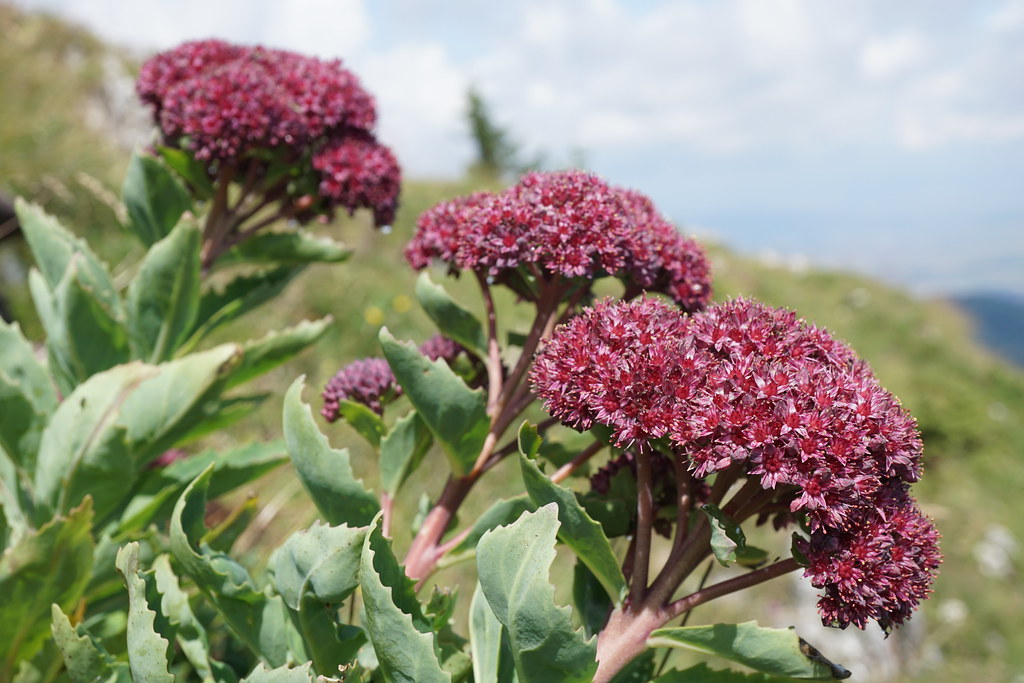
Orpine (Sedum telephium) is a succulent plant found in woods and hedges in most parts of Britain. Its flowers bring a rose-red flush to many woodlands in late summer and early autumn.

The stems and leaves of orpine store water, enabling it to survive prolonged drought and withstand being picked. This power of resistance is illustrated by an old country custom by which a girl who wanted to get married would hang a pair of orpine stems side-by-side in her house. If they grew together she would be happy with her chosen husband, but if they grew apart the outlook was bleak. If one of the stems withered quickly – which was unlikely – a death was in prospect.

Orpine also appears to have worked as a fly repellent!

Orpine grows to a height of 8-24 inches (20-60 cm). The clusters of upright, unbranched stems are often reddish. The pale green leaves, which are fleshy, alternate up the stem. The flowers, which appear from July to September, are rosy-red and are borne on long stalks in globe-shaped heads. The fruit is purple and does not spread out when ripe.

The name derives from ‘orpiment’, an Old French name for ‘a golden pigment’, although orpine has no gold about it. The name was originally given to a yellow-flowered plant of the same genus, but after translation was given to a plant that was wrongly believed to be the same species.

© John Welford

Monday, 28 September 2020

Downy-rose


There are two varieties of downy-rose that are commonly found in woods, hedgerows and scrubland in England and Wales. These are the harsh downy-rose (Rosa tormentosa) and the soft downy-rose (Rosa mollis). The terms harsh and soft refer to the texture of the leaves, and the fine downy growth on the leaflets gives the plant its name.

The downy-rose is an open shrub having long slender stems that bear numerous pink or white flowers. It grows to between 36 and 72 inches (90-180 cms) high. The flowers appear on long stalks in June and July.

The arching stems of the harsh downy-rose have leaves that are pale green when young. The thorns are slightly curved. The soft downy-rose is straight-branched with grey-green young leaves and has straight thorns.

Like many wild roses, the downy-rose is frequently attacked by a species of wasp called the gall-wasp. The gall-wasp punctures the plant and deposits its eggs, producing on the stem a tufted growth called a gall which is caused by the larvae feeding on the stem. On downy-roses such galls are bright red and, as a result, have been called “robin’s pin-cushions”.

© John Welford

Wednesday, 26 August 2020

Dog rose


The dog rose (Rosa canina) is the ancestor of the cultivated garden rose and has been a symbol of the British monarchy and England itself ever since it was adopted by King Henry VII as his official emblem, the “Tudor rose”.

However, the use of the word ‘dog’ to describe a plant usually implies that it is something of no worth, and that does sound very strange in this case.

One possible explanation is that the ancient Greeks believed that the roots of the plant could cure a man who had been bitten by a mad dog. The Romans adopted the name Rosa canina and that translates to English directly as dog rose. The name has therefore stuck.

The dog rose is common in hedgerows and scrubland throughout England and Wales although rare in Scotland. It is a climbing plant with arching stems that can grow up to 12 feet (280cm) long. The stems bear strongly hooked thorns and each leaf has two or three pairs of toothed leaflets.

The plant flowers in June and July with the light pink flowers being flat with large petals. The fruits, known as hips, are oval and smooth.

Whatever the dog rose’s supposed usefulness in curing the bites of rabid dogs, the syrup made from rose hips is rich in vitamin C.

© John Welford

Wednesday, 19 August 2020

Burnet rose


The burnet rose (Rosa pimpinellifolia) is found throughout Great Britain on downland, heaths and dunes, especially near the sea. For many years, varieties of this flower have been popular garden plants. Its rootstock suckers freely, spreading vigorously underground from the main root in producing new flowering stems at a distance from it. A single hybrid rapidly fills out into a dense bush covering a large area, which makes the plant popular with gardeners.

Botanists once called the burnet rose Rosa spinosissima, which means ‘the spiniest rose’ due to the large number of thorns. Another characteristic, unique among wild roses, is the purple black swelling or ‘hip’ that forms on the end of the flower stalk after fertilisation. All other wild rose hips are red or scarlet.

The burnet rose is an upright, spiny, bushy plant that grows to between 6 and 24 inches (15-60 cm) in height. The stem has many spines and bristles. The leaves are hairless, and each leaf has seven to nine small, toothed leaflets.

The plant flowers between May and July. The flowers are solitary with woody styles. They are creamy-white and sometimes splashed with pink. The fruits are round, with a crown of long sepals.

Both the common and the scientific names of the burnet rose derived from the close resemblance of its leaves to those of the burnet-saxifrage (Pimpinella saxifraga), which is a member of the parsley family.

© John Welford


Monday, 17 August 2020

Great burnet


Great burnet (Sanguisorba officinalis) is a plant that is found on damp grasslands in central England and Wales.

The plant grows from 12 to 36 inches (32-90 cm) high and it flowers between June and September. The stems are upright and hairless. The leaves are composed of paired rows of toothed leaflets.

The flowers of this plant are bisexual, in that each flower has both male and female parts that produce abundant nectar for insect pollination. Each flower-head has an oblong outline. The fruit has four wings.

People who studied herbs in the past believed in what was known as the doctrine of signatures – this meant that plants advertised their medicinal powers by outward signs. In the case of great burnet, the dark crimson flower-heads suggested blood, and for centuries the plant was used to staunch wounds and as a remedy for internal bleeding.

In more recent times, a root of great burnet, if freshly dug up and peeled, was applied to burns to relieve the pain and encourage healing. This reputation is preserved in the botanical name, the first part of which means blood-absorbing.

Great burnet is not as common as it once was due to the increased efficiency of British farming.

Salad burnet, which can indeed be eaten in salads, is related to great burnet but is much smaller having male only flowers in the lower part of the head, which flower first, while the female and bisexual flowers, which are higher up the head, open later. This is a common device used by wind-pollinated plants to avoid self-fertilisation.

© John Welford

Thursday, 30 July 2020

Charlock


Charlock (Sinapis arvensis) has long been a bane of arable farmers as it is a persistent weed that chokes spring-sown crops. Although modern farmers can control it by using weed-killers, it can still be seen growing vigorously on field margins, roadsides and abandoned land across Great Britain and elsewhere.

Charlock grows to 18 inches (45 centimetres) in height. The thick, hairy stems bear unlobed leaves that are large at the base of the stem and smaller higher up. The bright yellow flowers, which appear between May and July, are notable for having sepals that spread out horizontally below the petals. The seed pods are cylindrical, sticking out from the stem, with the seeds forming in two separate rows, one on each side of the pod.


A single charlock plant can produce hundreds of seeds. Not only does this make it difficult to control the plant, but the seeds are extremely long-lived. It is not unknown for a farmer to plough up a long-established pasture and find that it soon turns into a sea of yellow, due to buried charlock seeds, maybe as much as 50 years old and dating from the field’s previous use as a cornfield, being brought close to the surface where they can germinate.


Charlock has been used for food in past centuries, being boiled as a vegetable.


© John Welford


Tuesday, 28 January 2020

Lady's mantle


Lady’s mantle (Alchemilla vulgaris) grows all over the British Isles, apart from the Channel Islands.

The plant grows to about 18 inches (45 cms) high, with some stems growing upright while others sprawl along the ground. Each leaf has up to 11 toothed lobes.

Lady’s mantle flowers from June to September, the flowers being unusual in having no petals, only sepals in two rings of four. The hairy fruits ripen in loose clusters.

The plant exhibits an unusual feature called guttation. When humidity is high and water cannot be lost from the leaves as vapour, lady’s mantle forces the water out through its “breathing holes”. This gives the impression of large drops of dew which are not found on neighboring plants.

This phenomenon gave rise in medieval times to the notion that this “dew” was “celestial water” that had magical properties. Alchemists would collect it at dawn in the hope of using it in their experiments aimed at turning base metals into gold. One wonders why they kept on trying, given that every experiment must have been a dismal failure!

This usage is the reason behind the botanical name of the plant.

The name “lady’s mantle” has a different origin, in that it is supposedly dedicated to the Virgin Mary. That has led to the plant being used to treat women’s ailments. One notable past use was to help middle-aged women to restore their breasts to the shape and pertness they once had. Did this work? Presumably enough people must have thought so, otherwise the usage would surely not have entered folklore as it clearly did.


© John Welford

Parsley piert


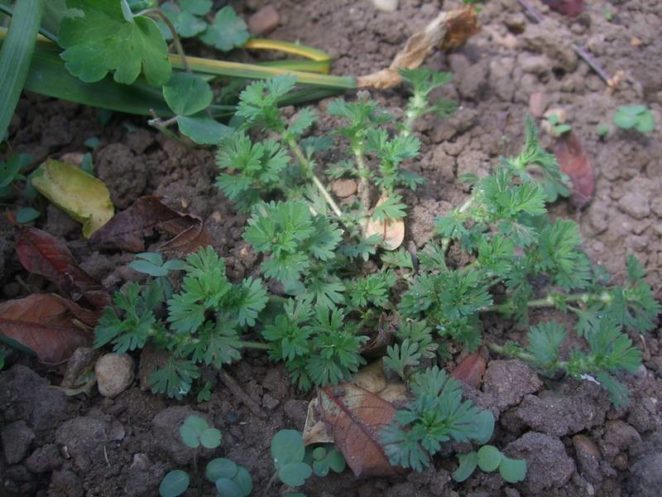
Parsley piert (Aphanes arvensis) grows on arable land and wasteland throughout the British Isles. Despite the name, it has nothing to do with parsley. The name is a corruption of the French “perce-pierre”, which means “stone piercer”.

Parsely piert is a sprawling plant that grows to no more than 8 inches (20 cms) high. The leaves, which grow on short stalks, have three segments that are lobed at the tip.

It flowers from April to September, the tiny flowers being green and having no petals but only sepals. The fruits are oval in shape.

Because the plant often grows in stony ground it was often assumed that it had broken through solid rock to reach the surface, hence the name. However, this is simply not true. This belief led to the notion that a medicine made from parsley piert would break up gallstones and kidney stones. One has to assume that any cures were purely coincidental!

Anther medicinal use in former times was to treat intestinal complaints. This led to the alternative names of “colicwort” and “bowel-hive-grass” (hive is another word for inflammation).


© John Welford

Wednesday, 8 January 2020

Wood avens


Wood avens (Geum urbanum) is found throughout the British Isles in shady places with damp, fertile soil. It is an upright, hairy plant that grows to a height of between 12 and 24 inches (30-60 cms).

Some leaves grow on stalks rising directly from the base, each bearing two or three pairs of leaflets of unequal size. The upper leaves that grow from the stem of the plant have three lobes.

The yellow flowers, which appear from June to August, are upright with turned-back sepals and spreading petals. The seeds are hooked and spread by being caught in the fur and feathers of passing animals and birds, as well as the clothing of human passers-by.

Wood avens has a remarkable mythology attached to it. It was thought to have an association with St Benedict, who founded the Benedictine order of monks. An alternative name is herb bennet.

This belief gave rise to notions that the plant had mystical or magical powers. A medical treatise of 1491 stated that “if a man carries the root around with him, no venomous beast can touch him”. It was also thought that hanging wood avens over one’s doorway would prevent the Devil from crossing the threshold!

Apart from these remarkable supposed powers, the roots of wood avens, which have a delicate clove-like smell, have been used as a fly repellent and for flavouring.


© John Welford

Thursday, 19 December 2019

Agrimony


Agrimony (Agrimonia eupatoria) may sound like some sort of disease but is in fact a common wildflower that grows over most of Great Britain, being found in field margins, hedgerows and on roadsides.

In ancient times this plant was widely used for medicinal purposes, being thought to be a remedy for liver complaints, poor eyesight, memory loss and even snakebite!

The plant was formerly thought to have magical qualities in southwest England, being known as fairy’s wand or fairy’s rod. To counter this trend, the Church renamed it Aaron’s rod.

Another former use of agrimony was as a dye plant for wool, with a strong yellow colour being produced.

The stems of agrimony, which are upright, unbranched and hairy, grow to between 12 and 24 inches high (30-60 cms).

The plant flowers between June and August, producing spikes that bear numerous yellow star-shaped flowers with notched petals. These flowers, which have a scent reminiscent of apricots, attract bees and flies.

The fruits have a ring of hooks around the upper edge that are caught by passing animals which therefore help to distribute the seeds.


© John Welford

Thursday, 12 December 2019

Wild strawberry


Wild strawberry (Fragaria vesca) is the plant from which the much-loved domestic strawberry was cultivated in the 18th century. The so-called Alpine strawberry, which has smaller fruits than those of garden strawberries, is closer to the original wild form.

True wild strawberries grow in Great Britain in woods and on grassland, especially on chalky soil. Some plants that are found growing wild are actually descended from cultivated plants the seeds of which “escaped”.

The name strawberry has nothing to do with any notion of straw being used to provide a bed for the berries and protect them from slug damage. The name goes back to Anglo-Saxon times – before the year 1000 – which was long before the plants were cultivated. In the Anglo-Saxon form of English, one meaning of the word straw referred to small particles of chaff, which could be taken to indicate the scattering of pips on the surface of the fruit. Another meaning is to strew across the ground, which is what the plant does with its creepers.

The upper leaves of the wild strawberry have long stalks and three leaflets that are bright green on top and pale underneath. The lower leaves form a rosette. The plant can grow to anything between 2 and 12 inches in height (5-30 cms). nk!

Flowering is from April to July. The fleshy fruit, which turns red when ripe, is known as an achene. This is equivalent to the central part of a raspberry, to which the seed-containing fruits are attached, but in the case of the strawberry the seeds are on the outside of the fruiting body and not contained within.

Strawberries also reproduce by sending out runners to form new plants.


© John Welford

Tuesday, 1 October 2019

Tormentil


Tormentil (Potentilla erecta) grows widely in Great Britain, preferring light acid soil.

It grows up to 20 inches high, the upper leaves having three leaflets and two leafy stipules.

The flowering stems grow from a rosette of leaves that often wither before the flowers appear, which is between May and October.

The yellow flowers, which look a bit like those of buttercups, have four sepals and four petals. They produce a nectar that attracts insects, but the plant can also self-pollinate.

Each flower produces up to twenty fruits in a small solid receptacle.

Tormentil was used medicinally in past ages. In a book published in 1616 a powder made from tormentil roots was recommended as a cure for toothache.

The plant was also used as a source of red dye and its highly astringent roots could serve as alternative to oak bark in the tanning of hides.


© John Welford

Silverweed


Silverweed (Potentilla anserine)  is a variety of cinquefoil that has the more usual yellow flowers, and its silvery leaves are divided into up to 12 leaflets.

It was an important crop plant in earlier times before the introduction of potatoes. The starchy roots were eaten raw, baked or boiled, or ground down to make porridge or bread.

Traditional names for silverweed include “bread and butter”, “bread and cheese” and “seventh bread”.

It also had medicinal uses, being used to treat mouth ulcers, sore throats and internal bleeding.


© John Welford